
He didn’t wake up so much as he was poured from one container of consciousness into another.
Finch opened his eyes, and they immediately burned. The air was frigid, tasting of copper pennies and ancient, undisturbed damp. He was lying flat on his back on a floor as smooth and cold as church marble, but harder—much harder.
It was pitch black. A darkness so thick it felt like it was pressing down on his eyelids, filling his lungs. He couldn’t hear anything other than the ragged, wet whistle of his own breathing, echoing hollowly in the vault.
“Mr Finch?”
Betty’s voice came from everywhere and nowhere. It had lost its domestic, kitchen pleasantness, now sounding flat and resonant, like a stone dropped into a deep well.
Finch tried to sit up, but his limbs were made of lead. His overcoat was gone. He was wearing his thin shirt, already saturated with the cold.
“Don’t struggle,” another voice said. It was Bethan, her border cadence sharper now. “You’re on an incline, and the edge of the sump is closer than you think. You won’t float in that water. Nothing floats in the adit.”
A light flickered, then caught. It wasn’t warm tungsten; it was a cold, sickly blue light, emanating from a small, battery-operated lantern placed on the ground next to a heavy, black ledger, its covers made of split slate.
Betty and Bethan were standing over him, but they had changed. Bethan still wore the yellow oilskin, but her hood was down, revealing her blunt haircut, and she held the iron crowbar loosely.
Betty had discarded her cardigan. She stood straight and lethal, holding her hazel thumb-stick like a weapon of office. In the cold light, her silver hair looked like spun wire. Behind her, the blue illumination only deepened the blackness, hinting at massive, timbered drift entrances and the abyssal drop Bethan had mentioned.
“The survey was incomplete,” Betty said, picking up the slate-covered ledger. “The boundary isn’t a straight line on a map, Mr Finch. It’s a depth. A specific thickness of clay. The Laurel Adit belongs to Hope, not the Crown. It always has. The easement you are helping to fulfill is quite substantial.”
“Where am I?” Finch croaked. “What is this place?”
Bethan smiled, a thin, cold ghost of an expression in the blue glow. “A settlement, you said. This is where we keep the records. The physical records. Tell him, Betty.”
Betty opened the heavy ledger. Instead of paper, the pages were made of razor-thin sheets of split slate, etched with names in a sprawling, archaic hand.
“When you buy a house with a history, you assume the ghosts have all moved on,” Betty remarked, her eyes settling on him. “But in the valley, we don’t believe in wasting resources. Energy is recycled. The stone cut for Holy Trinity had to be replaced by something. When the quarrymen went down, the quarry stayed. It needed tenants. And when the miners perished in the caverns they needed to be replaced”
She ran a finger over an etched name.
“Finch,” she read, “Simon Peter. 42 years. London. Provisional Occupancy. 192 square feet of lower clay seam.”
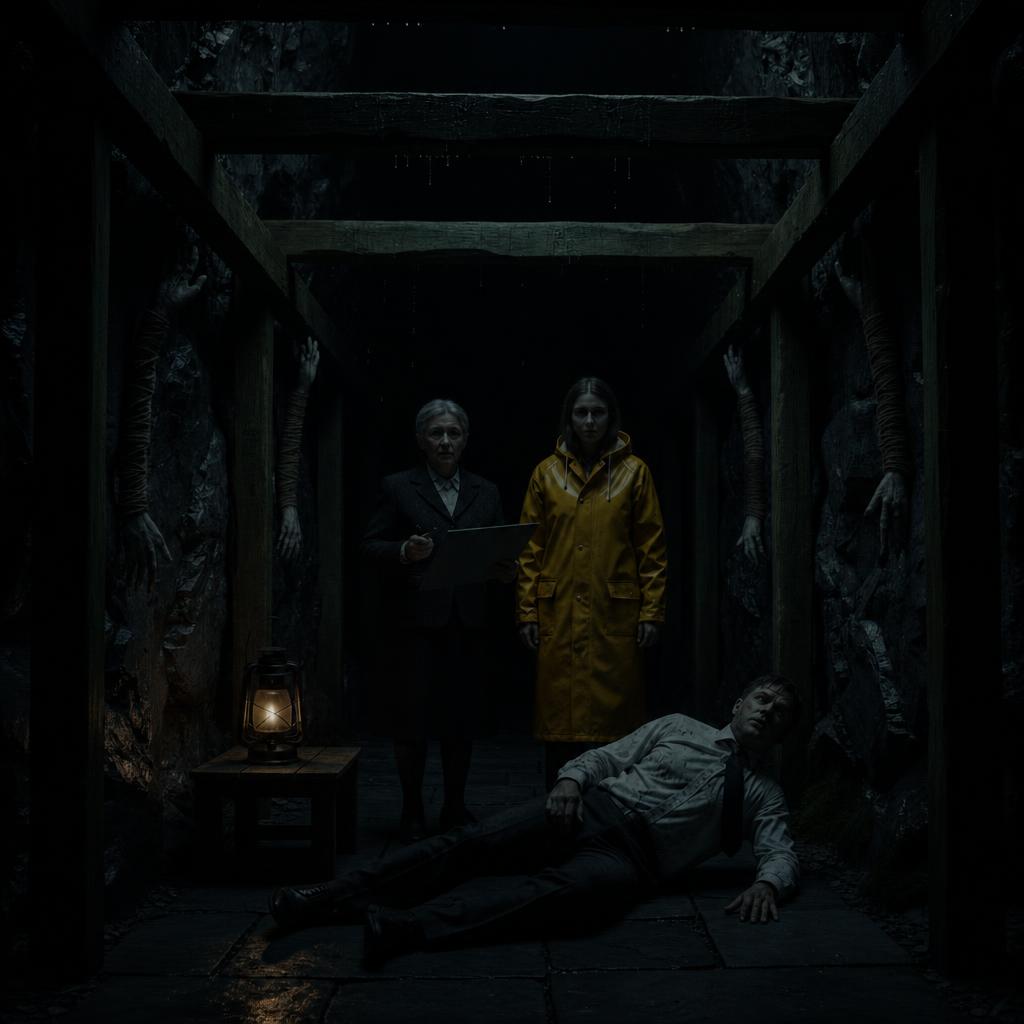
From the immense blackness behind the blue light came a sound. Not a voice, but a vast, dry, wooden groan, like a great timber structure flexing under impossible stress, followed by a wet, segmented clicking that echoed too fast to count.
Bethan turned her head slightly, looking into the darkness. “The Warden is restless. He doesn’t recognize the smell of your ink.”
“He will,” Betty promised, taking a pen that looked like a common nail from the slate binding. She looked down at Finch. “The Committee holds the lease, Simon. We just need your signature to activate the inheritance clause.”