
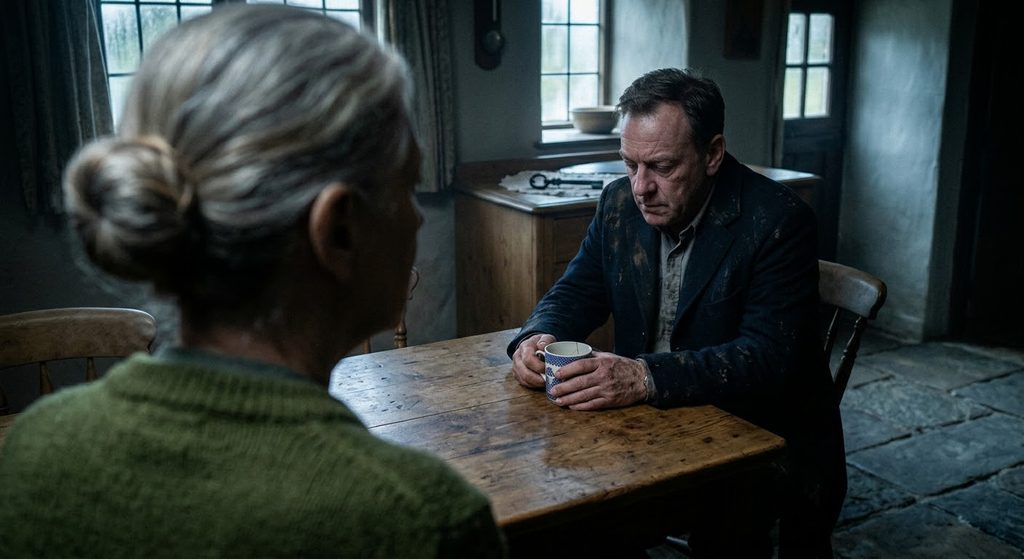
Inside Orchard End, the tea in Betty Preece’s kitchen tasted faintly of wet slate and copper pennies. Finch sat at the scoured pine table, his torn city trousers glued to his shins by clay, both hands cupped around a cracked willow-pattern mug. The warmth did nothing for the shivering inside his ribs.
On the dresser, between a row of marrow preserves and a brass carriage clock that didn’t tick, sat an iron key. It was eight inches long, heavy, and caked in white tallow. Next to it lay an ancient, double-ended pruning saw.
“You didn’t wipe your boots on the coir mat, Mr Finch,” Betty said mildly from the scullery, drying her hands on a linen roller towel bearing the crest of the Rural District Council. “The Shropshire clay has a habit of getting into the boards. Once it dries, you have to chip it out with an oyster knife.”
“Who was ringing the bell?” Finch’s voice cracked. “There’s nobody down there. The shop had a cardboard clock in the door turned to Back at 2, but the dust on the sill was an inch thick.”
“Empty is a very town-bred word,” Betty remarked. “Hope isn’t empty. It’s just settled. When you buy the Old Rectory out of a probate catalogue from an office in Mayfair, you assume you are purchasing four reception rooms, seven bedrooms, and two acres of mature beech woodland. You don’t read the easements.”
“What easements?”
“The right of way,” Betty said softly, taking a seat opposite him and folding her hands over her wool cardigan. “Not for the ramblers. The other one.”
“The woman in the churchyard… she was following me before the mist came up. She had a yellow oilskin.”
“Ah,” Betty murmured. “Young Bethan. The quarryman’s granddaughter. She’s keen. Very thorough with her boundaries, though she lacks my patience. Did she have the twine?”
“Twine?”
“Baling twine. Or the surveyor’s chain. Never mind, you’re here now.” Betty rested her forearms on the table. “Bethan didn’t find you by the yew, Mr Finch. She was simply herding you. Like a stray ewe off the common. We couldn’t have you wandering down toward the main road; the ditch at the bottom has three feet of water and the culvert is blocked. You’d have drowned yourself before we got the measurements.”
Finch stood up so fast his chair screeched against the flagstones. “I’m leaving. I have a car parked at the crossroads—”
“The Mercedes has gone of the road and the sump is cracked, dear,” Betty said without blinking. “You must have left the hndbrake off or perhaps Bethan took a crowbar to the drain plug while you were reading the parish noticeboard by the old post office.”
Finch backed toward the scullery door. His hand found the brass latch. It didn’t lift.
“You see,” Betty continued, “people think lead was the only thing dug out of these hills. Lead, and a bit of barites up at the bog. But before the miners, there were the folk who cut the stone for Holy Trinity. And long before Holy Trinity had a roof, there was the seam that didn’t show on the geological surveys..”
She picked up the iron key from the dresser.
“Bethan found the gate three winters back. Following a hare down the brook, she said, though God knows no hare ever had claws like that. An old drift, timbered with bog-oak that refuses to rot. It turns into a cave big enough to turn a horse and dray, with a floor as smooth as church marble and air so cold it preserves meat for eighteen months without salt.”
She smiled—a tiny, thin crease of the lips.
The latch on the scullery door lifted with a dry, iron snick.
Bethan stood on the threshold, dark hair cropped blunt at the jaw, yellow oilskin beading with moisture. In her right hand she carried an iron crowbar, its tip flecked with black underseal. Over her other shoulder hung a coil of surveyor’s chain. She set the crowbar down against the scullery dresser with a sharp, ringing crack, and pulled a folded piece of greaseproof paper from her pocket. Inside lay a cluster of small, pale roots, knotted and glistening, each ending in a jointed claw.
“Found them under the laurel gate,” Bethan remarked. “The frost hasn’t touched them. They’re tapping the limestone again.”
Betty poked at one of the roots with an index finger. “Bethan, take his coat. We don’t want good wool getting snagged on the brambles by the laurel screen. It’s nearly three o’clock, and the fog will be down on the brook before we’ve seated him.”